
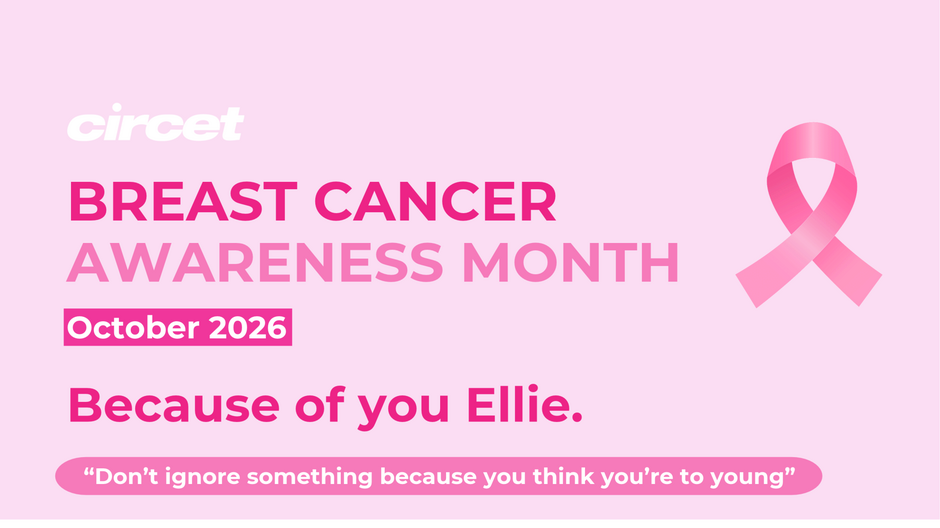
Because of you Ellie.
Because of you Ellie.
Ellie’s story is the story of our colleague Richard, who lost his wife to cancer 19 years ago when Ellie was just four months old. Today, at 19, Ellie is battling cancer herself.
Hi, I am Richard Wyatt, Head of Contracts for Traffic Management (UK South)
I’ve been off work for a few weeks because my 19-year-old daughter, Ellie, has been diagnosed with breast cancer. None of us ever imagined we would be in this position. As a family, we wanted to tell you Ellie’s story and use what has happened to us to encourage people to think about their own health.
This is particularly personal for us. Ellie’s biological mum, Rae, was diagnosed with breast cancer at 28 and died from the disease at 31, when Ellie was only five months old.
None of us could have imagined that, 19 years later, we would be facing breast cancer again with Ellie.
We are not sharing this to frighten anyone. Most changes are not cancer. We are sharing Ellie’s story because our experience has shown us that you should never assume you are too young to notice a change in your body or to get something checked. The message is simple: know your own body, know what is normal for you and, if something changes, get it checked.
On 23 July 2026, our family heard a word that changed everything: cancer. Ellie was diagnosed with grade 3 breast cancer. At her age, it was the last thing any of us imagined. Breast cancer in someone so young is exceptionally uncommon, and yet it happened to our daughter.
Before cancer, Ellie was just being Ellie. She was preparing to start her second year at the University of Stirling, studying Education, Philosophy and Religion. She had been working at the Orchard Bar in Falkirk for just over a year, earning her own money, learning to drive, spending time with family and friends and making plans for her future. She had a busy, independent life and plenty to look forward to.
Cancer was not part of the plan.
What followed was a whirlwind of appointments, scans, biopsies and conversations no parent ever expects to have with their child. Ellie started treatment on 4 August. She is now going through intensive chemotherapy and immunotherapy. She has had to stop working and defer university because the treatment, hospital appointments and side effects made it impossible for her to continue.
There are days when she is exhausted, anxious, isolated and overwhelmed. Medication can leave her confused, and ordinary things have become much harder. But there are still laughs. There are still family debates, television nights and jokes about the side effects. And there is still Ellie. Still debating subjects with Dad and, quite often, putting me firmly back in my place. If anything, cancer has not affected her ability to tell me exactly why I am wrong. That is something we are determined never to lose.
In February, she is due to have a bilateral mastectomy followed by breast reconstruction. For a 19-year-old woman only just starting adult life, the thought of such major surgery is incredibly difficult. It is not just the operation itself. There is the recovery, the scars and the reality of her body looking different afterwards. Like any young woman, Ellie has thoughts and fears about how she will look and how she will feel about herself.
She is 19. She should be worrying about university, work, learning to drive, holidays, friends and relationships. Instead, she has to think about how cancer and major surgery will change her body.
As her dad, that is incredibly hard to watch. You want to be able to tell your child that everything will be exactly the same afterwards. You can’t promise that. What you can do is stand beside her, listen to her fears and remind her that she is still Ellie. The surgery will change part of her body. It will not change who she is.
As part of Ellie’s investigations, she had genetic testing. This found she had inherited a gene called TP53, Li-Fraumeni syndrome. It means Ellie has a higher risk of developing certain cancers. It helped explain how breast cancer could happen to someone so young. It did not make the diagnosis any easier, but it gave us an explanation for something that had seemed almost impossible.
This is the part that matters most.
Ellie does not want people to read her story and become frightened. She does not want anyone thinking that every lump or change means cancer. She wants people to know their own bodies, understand what is normal for them and notice when something changes.
A lump or swelling in the breast, chest or armpit, a change in the size or shape of a breast, changes to the skin or nipple, unusual nipple discharge, or any persistent change that is not normal for you should be discussed with your GP. Most breast changes are not cancer, and you do not need to work out what they mean yourself. But you also should not ignore something simply because you think you are too young.
If Ellie could give one message to every woman reading this, it would be simple:
“Don’t ignore something because you think you’re too young.”
And this message is not only for women. If you are a dad, husband, brother, uncle, friend or colleague, don’t be scared to tell the women and girls in your lives to know their own bodies. Encourage them to check routinely. Sometimes all it takes is a simple question: “Do you check?” or “Have you checked?”
Encourage them to speak to their GP if something changes. Sometimes people just need someone to say, “You should have that checked” and “Have you had that checked?” So say it.
We want people reading this to stop for a moment and think about their own health. We want women to take a few minutes to become familiar with what is normal for them. We want anyone who has noticed a change, but has been putting off getting it checked, to pick up the phone. We want people to tell their daughter, their partner, their sister, their mum or their friend about Ellie, not because we want people to be scared, but because we want people to be aware.
If Ellie’s story encourages even one person to recognise a change, speak to their GP and get it checked, then something positive will have come from what has been an incredibly difficult experience for our family. That would mean a lot to Ellie. And it would mean a great deal to all of us.
Ellie did not ask for any of this. She should not have had to learn about chemotherapy, immunotherapy, surgery, genetics and cancer at 19. But she is facing it with incredible courage.
As her dad, I have watched her go through things I would give anything to take away from her. I have watched her lose her hair. I have watched treatment leave her exhausted. I have watched her worry about the future. And now I watch her prepare for surgery that will change her body and bring fears no 19-year-old should have to deal with.
But I have also watched her get back up and keep going. She is still making plans. Still laughing. Still debating with Dad and occasionally destroying my argument so completely that I have nowhere left to go. Still learning. Still being Ellie.
Cancer does not define who she is.
This is not something that is easy for a dad to write. It is not something I ever thought I would need to write. But here we are.
We are sharing Ellie’s story because, if it helps even one person recognise a change, pick up the phone and get it checked, then sharing it will have been worth it.
For Ellie.